Showing posts with label Bows & Arrows. Show all posts

Sunday, 12 June 2016

THE ADVANTAGE OF FEATHER FLETCHINGS


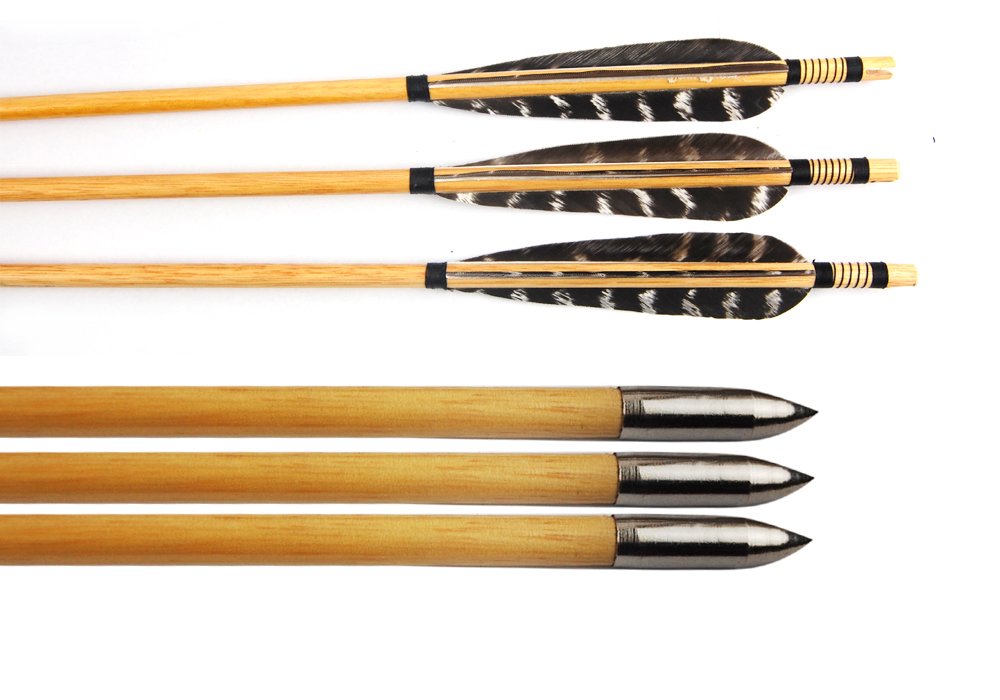
When I first took up archery, I was taught that the cock feather should always face away from the riser, or else the bow would deflect the arrow slightly and possibly tear off the plastic vane. What I was not told, until a year later by another archery instructor, is that when using arrows with feather fletchings, this is not an issue, since the malleable nature of feathers means that they do not cause deflection when the arrow passes the bow, unlike plastic vanes. 

A few weeks later, when I considered attempting speed shooting but found that taking care to have the cock feather correctly placed slowed down the process too much, I put this theory to the test. What I was told about feather fletchings proved true: it made no difference which way the cock feather faced, since there was no notable deflection. 

With this in mind, I am going to start working on blind nocking. That is to say, nocking the arrow without looking at it, but getting the arrow in place by feel alone, while looking ahead at the target at all times. This is, of course, how horseback archers would have to nock arrows. While it is not necessary in any other instance, it may well be helpful for speed shooting. A pointless activity speed shooting may be, but it might be fun nonetheless. 

Sunday, 1 May 2016

A WEAPON OF PEACE


A short video I made inspired by a couple of short texts I love on how archery has happily gone from an art of war to an art of peace.


Wednesday, 27 April 2016

SMALL TARGET PRACTICE


I have been working on improving my accuracy at short distances. In particular, I am trying to become accustomed to the subtle differences in movement when moving from one target to the next, which is quite necessary in field archery. Below are a couple of very short videos I made for fun from filming today's practice shoot.

I am using the KG Osprey Field Bow and wooden arrows. Links to both of these are in the description of the first video


Trying to hit the centre of each target:


Grouping on one target:


Thursday, 24 March 2016

DABBLING IN YOUTUBE


Filming myself shooting often is helpful for recognising where I am going wrong with my form. I was not thinking of making a Youtube video, but in a few moments of boredom and curiosity, I thought I'd try my hand at it with what terrible footage I had at hand in my phone. 


Tuesday, 23 February 2016

INSCRIPTIONS


Some inscriptions found on bows, arrows and quivers, taken from the book, Arab Archery.


ON BOWS


More dreaded by the dauntless foe
Than any other warlike blow,
Come the wooden shafts which are
Shot with bows that send them far.
They fell his ranks, line after line,
And shower them with death divine.
Piercing through the shield and mail,
They cause the breath of life to fail.

* * *

It falls to me to wield the bow and bend its limbs,
Though in the act of death my arrow far excels it;
For if to slay the foeman marks a weapon's rank,
What can surpass that one which pierces through him?

* * *

Elegant in form and wonderful in structure!
When such a thing is sought, the Arab bow is found.
If enemies approach, it welcomes them with arrows,
Laden with death and bearing fear and awe.
Such is the Arab bow, with victory bound of God;
His holy writ and revelation with its arrows spreading.


ON ARROWS


An arrow from a warrior,
Shot at an unbeliever,
Counts more than many prayers
Said by a pious hermit.


ON QUIVERS


I am full of fatal arrows;
My merchandise is death and pain.
Learn by what thou hast seen of me.
I am the blight of the wide world.


Tuesday, 2 February 2016

HORSE BOW REVIEW: A Comparison

The XL Scythian Recurve bow
Very soon after I knew that archery was going to become a long-term obsession, I became drawn to horse bows. They look beautiful, they do not require a stringer to set them up, they are relatively small and therefore easy to take around compared to other one-piece bows, they can be used by left or right handed archers, and they are easier to pull than other bows of equal power. That being said, it is not easy to become accurate with such a weapon. Therein lies the challenge and the fun of the horse bow, with or without a horse.

My Scythian horse bow with bow quiver,
bamboo arrows, and a cycle for a horse.
My first horse bow was the XL Scythian Recurve Bow from Merlin Archery, which pulls 30-35 ibs. An attractive fiberglass bow wrapped in leather, with a price tag just over £125, it is an excellent choice for a first horse bow. It is extremely easy to pull. 30-35 ibs feels like 20, and it is surprisingly powerful, at least up to 20 yards. One little niggle is the arrow pass on the left side of the bow handle. I am pleased this is there to prevent the leather being destroyed by the arrow, but 1) it assumes the archer is right-handed (I want to donate this bow to a left-handed archer), and 2) it assumes the archer, even if right-handed, will be placing his arrow on the left side of the bow. Considering some archers of the Eastern persuasion place the arrow on the right side, I do not see why they could not have placed an arrow pass on either side, as is the case with the Istvan Toth Tatar bow. 

Istvan Toth Tatar bow
My latest horse bow is a 45 ib horse bow which I acquired through Amazon. The price tag was around the same as the Scythian bow, only included in the price were six arrows (superb quality self-nocked wooden arrows with broad head tips), an arm bracer and a finger guard. The arrows alone are worth around £50. The cheap cost and the photos gave me doubts, but the glowing reviews gave me hope, so I took a risk, and I am glad I did. It is a beautiful bow and it performs extremely well. The wooden siyahs (limb tips) are excellently designed, keeping the string securely in place when strung, and making it very easy to keep the string from twisting when unstrung. While I have yet to use it enough to determine the durability of the leather wrapping, it looks attractive, and the handle is designed so as to proffer some indication of the position of the shooting hand while protecting the bow from the arrow when shooting. There is no arrow pass, and so it easily lends itself to shooting from either side and is equally usable for right and left handed archers. 


Mongolian pigskin bow
While there must be better horse bows out there, this combination set from Amazon is real value for money. If you are new to archery or to horse bows, I would suggest beginning with the Scythian bow from Merlin. When you are ready for a higher poundage, I can not recommend the Mongolian pig skin bow and matching arrows from Longbowmaker highly enough.

Monday, 25 January 2016

POWERFUL BOWS, WEAK ARCHERS


Is it just me, or do fantasy literature and "historical" film give the impression that the bow is the ideal weapon for women, delicate elves and effete men? Think of a battle-axe, war-hammer or broadsword, and you probably imagine them in the hands of some big, burly male warrior; think of a bow and, apart from Robin Hood, you probably think of elves and heroines from fantasy films. But in reality it is the exact reverse. A war bow required incredible strength to pull. These were not recreational toys. If they were to cause any real damage from a distance and pierce armour, they needed to pull more than 75 ibs. This was not a weapon suited to effete, delicate creatures. Wielding a blade effectively required less strength than pulling such a bow. So, it does irk me somewhat that the bow is thought of as the weapon for slender pretty boys, not least because I am not one.


That being said, there is today the other extreme. Tell people about the kind of poundage war bows had, and suddenly the attitude (at least amongst men) is that the higher the poundage the better. I find this irritating because there is really no need for war bows anymore. If you are bow hunting, then you need a bow that pulls at least 40 ibs (and arrows suited to such a pursuit). That aside, unless you are taking part in flight archery competitions, I see little point in having a bow that exceeds 50 ibs. 

What's more, I have noticed archers who are proud to have a bow that pulls 50 ibs or more, yet they never manage to pull it to full draw. In other words, they are not actually pulling the draw weight of their bow, as the draw weight is measured according to the draw length (usually 28 inches). So what is the point of bragging about having a 50 ib bow when you are only pulling 40?

If you want to shoot far or penetrate anything of value, it is not a powerful bow you should be concerned with, but acquiring the strength to pull it.


Sunday, 3 January 2016

FLETCHES: ARE FOUR BETTER THAN THREE?


In all forms of archery, arrows nearly always have three feathers. One of them, called the cock feather, is at a right angle to the nock, and it is usually a different colour to the other two feathers. The reason for this is so that the archer can more easily discern the cock feather because it should be facing outward to avoid friction throwing the arrow off when it flies past the bow and tearing the feather off. This type of arrow was used by English longbow archers, Kyudo practitioners, and by the vast majority of traditional and modern archers today.

An arrow will fly with two or even no feathers, but it will not be as efficient. Three feathers are required for the arrow to stabilize properly in flight. But considering the extra time needed for the archer to make sure his arrow is placed on the bow correctly, why not four feathers? I had some wood arrows custom made with four feathers to test. Alas, the plastic nocks that were placed on the arrow had very small fins slightly protruding from the nock, thus compelling one to think in terms of placing the arrow on the bow in a particular position. It was hard to tell if and to what extent the nock was effecting flight when placed with the offending little fin inwards, but I found it off-putting nonetheless.

My reason for wanting four-fletched arrows was to eliminate concern for the position of my arrow when nocking it, which would speed up the process of nocking an arrow. While I have no reason to master rapid fire during archery, sometimes I do get a little annoyed by the time required to nock a three-fletched arrow. Ancient horse bow archers did indeed use four-fletched arrows. They had no time to spend nocking arrows while charging on horseback on the battlefield, unlike longbow archers, who were stood in ranks away from the midst of battle. 

To my surprise, I found that the four fletches did not make any difference to the performance of the arrow. Whether four feathers would improve the stabilization of the arrow in windy conditions, I cannot yet say. The only advantage I can see is speeding up the time the archer needs to shoot an arrow.

While I am sure to never find myself on horseback in the middle of a battlefield, thinking, "Damn, if only I had four-fletched arrows that I may dispatch these infernal orcs with greater speed!", I am inclined to procure some four-fletched arrows with less obtrusive nocks, just so that I can enjoy more time shooting and less time nocking.


Friday, 1 January 2016

THE HORSE BOW AND THE MONGOLIAN THUMB RELEASE


The XL Scythian horsebow from Merlin Archery
This fine morning I made my first serious attempt at learning the authentic method of using a horse bow: using the Eastern, or Mongolian, thumb release. 

I know that there are many fans of the horse bow who are eager to learn this style of shooting, but who are perplexed by it. I am therefore eager to share my experience of experimenting with this technique and what I have learned so far.

Equipment and distances

First of all, a few details about the equipment I was using. My bow was a Scythian horse bow which pulls 30 - 35 ibs at 28 inches, and with a maximum draw of 32 inches. I used two different sets of arrows, which worked equally well: my Gold Tip Traditional carbon arrows (500 spine, 31 inch length, 100 gram tips and 4 inch feathers), and my XX75 Platinum Plus aluminium arrows (19/16, 29.5 inch length, 3 inch feathers).

Archer's thumb ring
I am still waiting to receive a thumb ring, so I practiced the technique without it, drawing with my thumb around the string and locked into place with my forefinger and middle finger, and releasing by opening my hand and moving the elbow outwards (from what I have observed this is the traditional method of release for horse bows). Fortunately, my Scythian bow is quite easy for me to pull without a thumb ring, though it did become a little strenuous after much repetition.

I practiced the thumb technique from 15 yards and 20 yards, and, to my surprise, the results were very much the same from both distances.

Right or Left Side?

Due to Lars Andersen's viral video on archery, some may be of the opinion that the rapid fire of the horse archers of yore was down to placing the arrow on the right side of the bow (for left-handed archers, it would be the left side). Lars Andersen's video demonstrates that it is possible to shoot this way, but when I tried it (both with the bow canted and with the bow upright) the arrow, rather than flex around the bow, flew off to the right and completely missed the target. It seems to me that the arrow needs to be on the left side since it first flexes to the right. It is possible that the choice of wing feather (left or right wing) may have some role to play here, and that not all arrows behave the same way. 

My own meagre experience aside, I have noticed that the most notable horse bow archer, Lajos Kassai, as well as some Eastern archers, do indeed place their arrow on the left, just as Western archers do.

Aiming

The first thing which struck me about using the thumb technique is how far to the left my arrows would fly in comparison to where I was standing and aiming. I had already noticed this pattern with my horse bow when using the Mediterranean release (I assumed it was just down to having the wrong arrows, different to the ones I was now using), but it was more acute when using the thumb release. I continued to adjust my position and aim accordingly, until eventually my arrows would land where I wanted. 

This was most frustrating, and I racked my brains for an answer to this problem, suspecting there was something wrong with my technique, with my bow or with my arrows. I was certain my arrows were not the problem, for they were penetrating the target straight and not at an angle, so I believe they were matched to the bow. On previous occasions when I used the same horse bow with wood arrows not quite suited to my bow and employed the Western method of shooting, the arrows would penetrate from all angles, but mostly with the nocks to the left, suggesting that they were too weak for the power of my bow. 


I later ceased trying to imitate the release as demonstrated in the above link, and instead simply opened my thumb and fingers while drawing my hand back a little to avoid inadvertently torquing the string, and the arrows began flying far straighter. Clearly my attempt at the "open arm" release, which I had seen, was torquing the string considerably, making my arrows fly to the left. By simply opening my thumb and forefingers, I was getting a much cleaner release.

Speed and penetration

The second thing I noticed was a marked difference in the speed and penetration of my arrows. I expected the thumb technique to give me a cleaner release, but I was truly surprised by the increased velocity of the arrows. As yet I have no idea why the thumb technique has this effect.

Anchor point and consistency

I then turned my attention to the problem of anchor points. I had observed previously that notable horseback archers, such as the remarkable Lajos Kassai, would shoot from the breast, with no clear anchor point I could detect. I found it very difficult indeed to acquire any consistency with this method. It is a method which makes sense for an archer mounted on a charging horse. For mobility would surely make a normal anchor point very difficult to maintain. 


If I had any consistency it was only vertically, with arrows forming a line across the target, but no real grouping. I then decided to make my anchor point (as seemed fitting for the bow and method I was using) the side of my jaw/front of my ear. Once I began using this as my anchor point, some consistency began to form. 

Towards the end of my two-hour session of practice, I was taken aback by the degree of accuracy and consistency in some of my rounds, with three or four arrows very closely grouped together on some occasions. 

This proved to me that however different this weapon and method of shooting to other bows and styles - traditional and modern - it is indeed possible to master consistency and accuracy as well as speed with this remarkable weapon and Eastern style of archery.

A different kind of archery

I realised that I had the horse bow all wrong, and I came to appreciate the Eastern method of archery like never before. I will never shoot a horse bow with Western eyes again. 

Now I can truly enjoy two different styles of archery: the Western style and the Eastern style. Twice the know-how: double the fun!


Wednesday, 30 December 2015

THE STRAIGHT AND ARROW PATH


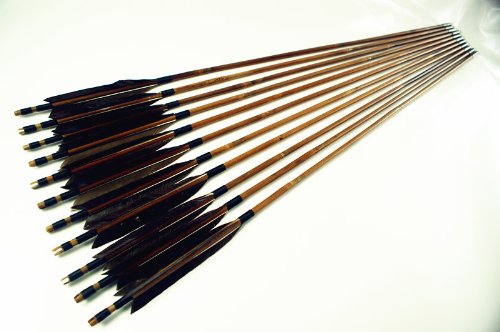
Confounded arrows! Nothing is so frustrating for a beginner in traditional archery than arrows, particularly wood arrows. Yes, I know, we all like the idea of wood: it is how archery has been done for centuries, it is traditional, and it is aesthetically more pleasing than aluminium and carbon. But let's face it: they crack and bend too easily, and they are not as proficient as their modern counterparts. So thanks be to Apollo and Artemis and Cupid! There is a way of marrying the beauty of a traditional wooden look with durability and efficiency: carbon arrows painted to look like wood with feather fletchings. I acquired such arrows from Merlin Archery (image below). They look beautiful and perform wonderfully.


I was told that when shooting with a horse bow or longbow, one should really use wood arrows, as they flex better around the bow than do aluminium and carbon. Experience taught me this is nonsense. It is simply a matter of discovering the right arrow measurements for your particular bow. While this is also true of wood, there is a great deal more luck in finding the right wood arrows.

Whenever I tried to consult the more experienced on finding the right arrows to match my horse bow, I was met with much hesitation and doubt. I have been told that there are so many variables that one could not possibly provide any suggestions, lest they be proven wrong at my own expense. "It is trial and error" I was told. While it may be true that one must test arrows until (s)he finds the right ones, I would like to proffer some suggestions for beginners in the hope I may spare you a few shillings here and there on your quest to finding what works for you.

Here are some basic but important factors regarding arrows:

Arrow length

One of the first things that would be determined when you first have a go at an archery club or when you wish to purchase your first bow is your draw length. The average draw length (against which the poundage of bows is generally measured) is 28 inches. It is therefore customary to refer to the poundage of a bow at this draw length. So a 50 ib bow usually means it pulls 50 ibs at 28 inches. The arrow length is measured from one end of the shaft to the other, and does not include the heads and nocks which are placed at each end. Nonetheless, one's arrow length should be at least a couple of inches longer than the archer's draw length, since it is possible, particularly after a bow has been used a few times, to pull beyond the average draw length. An arrow too short could lead to impaling one's bow hand with the arrow. So for a 28 inch draw, one should acquire arrows of 30-31 inches. While one may think that it is safer to get a longer arrow, the length does effect the flexing of the arrow, so do not go too far with safe lengths. The shorter the arrow, the stiffer it will be.

Spine thickness

One of the most difficult measurements to figure out with wood arrows is spine thickness. Fortunately, some arrow makers and sellers present arrows suited for bows by poundage, which makes life a lot easier. When this is not the case, it can be hard to know how the arrows will behave. One way of knowing whether your arrows are too thick or too thin for your bow is by whether the arrows are penetrating your target straight or are entering in from the left or right. If one is a right-handed archer and arrows are persistently entering their target with the nocks to the left, it means the arrow is too weak. If they are entering with nocks to the right, the arrow is too thick. Generally, arrows being shot from bows without a shelf need to be weaker in order to flex around the bow. If arrows are penetrating the target from all angles, it is possible that the problem is your release, not your arrows.

In my experience, carbon arrows are suited to a broader range of bows than wood. For example, with a 500 spine and 100 gram arrow heads, my 31 inch length carbon arrows shoot straight from my 30-35 ib horse bow, my 40 ib longbow and my 30 ib modern recurve bow. My wooden arrows (available from Amazon - see image below), 82-85 cm in length and 8 mm in diameter, shoot straight only from the 40 ib longbow.


Arrow heads

Another important aspect of the arrow is the weight of the heads. The greater the weight of the head, the more the arrow will penetrate, but too heavy and the arrow will lose velocity in flight too soon. 

Fletchings

Thankfully, there is little for the archer to really worry about in this regard save for aesthetics. At least three feathers are required to stabilize an arrow in flight. Nearly all arrows are fletched with one feather of a different colour, as this is the feather that is supposed to be facing away from the string when nocking the arrow to avoid knocking the arrow off course as it flies past the handle. However, this is not as important with feather fletchings as it is with plastic, since the former are more flexible and forgiving. For traditional bows, feather fletchings are better than plastic, since the arrow has to further to bend around the bow handle to find the straight path to the target, and this feather interferes less with these kinetic shenanigans.

But even fletchings can get complicated. When customising or making arrows, one may be faced with the choice between right and left wing feathers, or the choice between straight or helical fletching. Helical, or offset, fletching is where the the vanes/feathers are twisted, which makes the arrow spin in flight, providing greater stability and therefore accuracy. Whether they spin right or left depends on whether your arrows are right wing (taken from the right wing of the bird) or left wing. I am not aware of any significant difference between right or left wing feathers, and they have no bearing on whether one is a right or left handed archer. The only important thing to consider is that the two are not mixed up, or one is likely to end up with inconsistent results. 

Material

With carbon, fibreglass and aluminium arrows, one need not worry so much about the quality of the material. Not so with wood. Arrows made of high quality wood are expensive. Considering how much more likely they are to crack when one arrow scrapes against another, or when you split the nock of your previous arrow with your next shot, or how much more likely they are to bend, you might really want to consider "traditional" carbon arrows, such as those available from Easton. 

Spruce and pine are a popular choice of wood in England these days, as they are fairly cheap, but I have been unimpressed by arrows made of these materials. I find cedar wood make for pretty consistent shooting, but even more impressive is bamboo (example bellow, available from Amazon), which is obviously the material for arrows in Chinese and Japanese archery.


CHOOSE YOUR WEAPON

Let us Begin

I shall spare you the customary introductions to archery. For you would not be here reading these words if the art had not already perked your interest. One need not investigate the matter with great meticulousness to know that archery is a very ancient practice, used by man for hunting, warfare, meditation and sport. Nor do I need to tell you why you and others like you favour traditional over modern forms, though it is quite inevitable that I will touch upon these subjects if you stay with me long enough.

I shall begin with the various kinds of traditional bows, their advantages and disadvantages, notwithstanding variations in quality and design. This is to help you decide your weapon of choice, though there is no reason, other than lack of resources, that you should not possess and use more than one. Let it be said, however, that for a beginner, it is advisable to spend considerable time with one particular bow before trying to master another, since bows which require different techniques and which shoot different distances with varied power, will demand constant change in the archer’s method, which makes mastering proper form more difficult.

The Flat Bow

“Flat bow” is a generic term for bows which are shaped much like a straight piece of wood when unstrung. The term “stick bow” is also used (at least for more primitive versions). It defines almost any bow which is not a recurve shape (more on recurves later). Flat bows may or may not have a shelf, or rest, upon which the arrow sits when shooting. Many archers favour bows with rests or shelves, as this provides the archer with the means of greater accuracy and consistency. Bows without rests, such as English longbows or horse bows, require that the arrow be placed on the bow hand, with one’s knuckle acting as the rest, or shelf. It is advisable for the archer to wear a glove on the bow hand, as the feathers can leave painful cuts as they fly across the hand when leaving the string.

Archers who shoot bows without an arrow rest often cant the bow when shooting so that the arrow does not fall off the knuckle (other bows are usually held upright when shot).

Flat bows vary in size, depending on the height and choice of the archer. Like all bows, flat bows come in various poundages: the higher the poundage, the more power stored in the bow, and the harder it is to pull the bow to full draw. But more on power later.

The Longbow

Longbows, while they are sometimes placed in the general category of flat bows, deserve a category of their own, not least because many archers favour the longbow due to its significance in English military warfare. There is no clear definition of the longbow, but technically a longbow is any bow that is taller than the user.

The legacy of the longbow is inextricably linked with the military strategy for which it was invented and employed by Welsh and English archers. The war bows of yore possessed a draw weight of at least 100 ibs. The training required for archers was not so much to become extremely accurate as it was to acquire enough strength to repeatedly pull the bow to full draw. Many archers in ranks with bows of such a poundage, shooting arrows with arrowheads designed to pierce chainmail or plate armour into the air, with the intention of raining down hundreds of arrows upon the enemy, was an effective military strategy at Agincourt, after which the longbow became somewhat legendary amongst the English.

Despite its legacy, and though I am sure to incur the wrath of longbow admirers, it is my opinion that the longbow has no advantage over other bows when it comes to target archery or field archery. While I have yet to shoot a longbow beyond 40 ibs at a draw of 28 inches, it is my experience that recurve bows and horse bows of a lower poundage can reach greater distances than longbows and most other flat bows.

If one’s primary interest is target archery, the only great disadvantage to a longbow is transporting the weapon from place to place. If one wishes to indulge in hunting, a longbow can be difficult to shoot from discreet places, due to its size. The longbow was certainly not designed for hunting.

The Recurve Bow

Perhaps the most common bow in our day is the recurve bow. This is the design of many modern bows, such as those used by Olympic athletes, but it is also the shape of many wooden bows. The advantage of the recurve is that the limbs are thin and flat, and toward the end of the limbs, the bow curves away from the archer. When the bow is strung, this recurve shape adds velocity to the shot, providing the archer with the ability to shoot greater distances, depending on the poundage of the weapon. Generally, a recurve bow will shoot greater distances than a longbow or flat bow of equal power.

A further advantage of many a recurve bow over the longbow is that the arrow rests closer to the centre. This means that the arrow does not need to flex around the bow as much as it does with a longbow when loosed (this flexing to and fro in flight until the arrow straightens is called the “archer’s paradox”, a subject to which we may return in future). Shooting from closer to the centre makes accuracy and consistency easier to master, and also makes picking the right arrows for the bow simpler.

While the vast majority of modern recurve bows are “take-down” bows (meaning the limbs can be detached from the handle, or “riser”), wooden or “traditional” recurves, which seem to be highly favoured by field archers, can be either “one-piece” or “take-downs". The take-down bow has two advantages over the one-piece bow. The first is, of course, ease of transportation. The second is that as one gradually increases his strength and ability to shoot higher poundage bows, the archer can, in many cases, acquire new limbs without having to acquire an entirely new bow. Naturally, this is a more affordable investment if one is a novice.

The Horse Bow

The horse bow is the original recurve, but it has yet a greater advantage over other recurve bows. When unstrung, the limbs curve away in the opposite direction from the archer. In some cases, as with many Turkish bows, the limbs form a C-shape when unstrung. The bow is strung in the opposite direction, towards the archer. This means that a great deal of power is stored in the bow when strung, even more so than other recurve bows, which are fashioned in that shape, providing only a little extra power in the limbs when strung. Moreover, because a great deal of power is already stored in the bow when strung and due to its short length, it is much easier to pull a horse bow than it is to pull other bows of a higher poundage.

It is for these reasons that the horse bow was very effective in warfare in Eastern Europe and the Far East. It was designed to be used by soldiers on horseback. The shortness of the bow provided ease of movement, while its power and easy draw meant that archers could shoot at great speed with enough power to pierce armour at short distances. The Huns were particularly noted for the rapid shooting of their mounted archers, while the Parthians became known for turning in their saddles and shooting toward the enemies behind them while on the move. This became known as a “Parthian shot”.

Some horse bows are asymmetrical. That is to say, the bottom limb is shorter than the top limb. This is particularly useful for horseback archery, as it provides greater ease of movement about the horse. But it also provides an extra “flick” to the arrow when shot.

It is very difficult to acquire consistency with a horse bow. As we have seen, these bows were designed for rapid shooting at various moving targets all around the archer. It is therefore little wonder that it is not often the weapon of choice for target archers. However, its small size and its power make it a reasonable choice for field archery, where one has to constantly adjust to targets of numerous sizes at various distances.

One cannot leave the subject of horse bows without referring to methods of arrow release. The authentic method for shooting a horse bow is considerably different to Western forms of archery. Eastern archers used what is called the thumb release, also called the Eastern or Mongolian release. This is in opposition to what is called the Mediterranean, or Western release. The Mediterranean release is pulling the string to full draw with the first three fingers, with the arrow in between the index and middle finger. The arrow is pulled back to what is called an anchor point (usually the corner of the lip or under the chin). The draw hand is then loosened, and sometimes drawn back to a second anchor point (such as the back of one’s ear). These anchor points assist the archer in maintaining consistent accuracy.

The Eastern release is very different, and often requires (at least for high poundage bows) a thumb ring. The archer, using his thumb pulls the arrow back to his anchor point, using the index finger, or index and middle finger, to lock his thumb into place, and then releases the arrow. The advantage of this technique is that there is less twist on the string than there is with the Western method, thus providing a cleaner release and therefore greater accuracy. However, many horseback archers draw back to and release from the breast rather than from the face or chin. While this certainly makes sense for horseback archery, where movement would make a normal anchor point difficult to control, it does make consistency more difficult.

How Much Power Do You Need?

It is important when one begins archery that (s)he begins with a low poundage bow. To shoot with a bow that is too great a struggle to pull to full draw persistently will lead to the novice developing bad form, or no form at all. This is called being “over bowed”. While it is undoubtedly a costly process, one must gradually adjust from lower to higher poundages, in 5 ib increments. When considering the poundage one would like to reach, (s)he should do so after considering the purpose of one’s archery. For hunting, 40 ibs is the minimum (but one must also consider the appropriate arrows, since arrowheads for target archery are designed to create minimal damage). In terms of distance, the power of the bow is not the only factor to consider. Every bow shoots differently, and some fly faster but penetrate less deep (this also depends on the arrow, of course). For target and field archery, if one wishes to shoot 30 yards or more, 35 ibs is usually sufficient, though again this depends on the bow: horse bows and recurves generally require less power than flat bows and longbows for the same distances.

What, no Crossbows or Compound bows?

Both crossbows and compound bows fall outside my field of experience and interest. Crossbows are entirely different weapons for which the methods of archery described herein have no bearing. As for compound bows, these are far too modern to earn a place in writings on traditional archery. So weep and lament, ye lovers of crossbows and confounded compounds! What ye seek will not be found here.